Home · Britain
Closer to home
Is there tundra in Britain?
Not in the Park Service sense. Arctic tundra lies north of the latitudinal treeline and alpine tundra above the elevational treeline, and Britain’s mountains are modest. [NPS Arctic] But one corner of Scotland is described in official papers in very tundra-like terms, and it is worth knowing.
The Cairngorms: Britain’s arctic corner
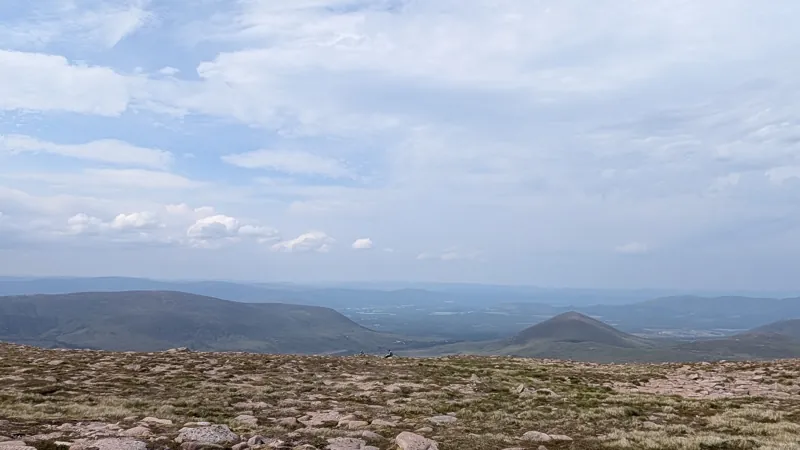
NatureScot’s citation for the Cairngorms Site of Special Scientific Interest calls the Cairngorm mountains the most important mountain area in Britain for nature conservation. It says the area includes the greatest area of high land in Britain, much of it unique for its “extensive arctic character”. [NatureScot]
The massive summit plateaux, with a considerable land mass above 1,100 metres, allow snow to lie for a long time. That gives the largest extent of late-snow vegetation in Britain. [NatureScot] In those late snow beds grow communities of least willow, Salix herbacea, with mosses and liverworts, which the citation says are more extensive and finely developed than anywhere else in Britain. They support a number of rare arctic-alpine herbs, mosses and lichens. [NatureScot]
The citation also lists breeding dotterel, snow bunting and ptarmigan among the special features. [NatureScot] All three are birds most people would associate with much further north.
The same document describes periglacial landforms, the marks of cold-climate conditions on bedrock and soil, extensively developed on the high slopes and plateau surfaces. [NatureScot] Frost shaping the ground is the same family of processes that draws polygons in the Arctic.
Our wording, not theirs: NatureScot uses “arctic character”, “arctic-alpine” and “montane”. It does not call the Cairngorms tundra, and nor do we. “The closest thing in Britain to tundra” is our summary, and only a summary.
Least willow: a tree you can step over
Least willow belongs to Salix, the same genus as the willow trees by a river, and in the Cairngorms it grows in the late snow beds. [NatureScot] It is a good reminder that “treeless” in tundra language often means no tall trees: the woody plants are still there, just lying down out of the wind.
An Isle of Man postscript
The Manx Museum in Douglas has a giant deer skeleton, a significant and very complete example, now the centrepiece of its Geology Gallery. It was articulated in the summer of 1897 by Caleb Barlow of the Natural History Museum in London, and was conserved and reinstalled in April 2016. [Manx National Heritage] During the conservation, samples of tooth and bone were taken for carbon-14 dating and DNA testing, to compare the Manx deer with its relatives in Ireland, Scandinavia and Russia. [Manx National Heritage]
The museum’s page does not give the dating results, and it does not describe the landscape the deer lived in, so we don’t either. For the ice ages themselves, see ice-ages.climates.im.