Signature tool
The Daylight Dial
The tundra’s strangest feature is not the cold. It is the light. Near the Pole, summer has no night and winter has no day, and the further north you go, the longer each lasts.
Our signature tool
The Daylight Dial
How long is a tundra day? Pick a place, or slide the latitude, to see a whole year of daylight: gold bars are hours of sun, bright gold is the midnight sun, and dark bars are days when the Sun never rises.
Utqiaġvik, Alaska · 71.3°N
- Midnight sun
- –
- Polar night
- –
- Longest day
- –
- Shortest day
- –
- Hours of daylight
- Sun up all day
- Sun never rises
| Place | Latitude | Midnight sun | Polar night | Longest day | Shortest day |
|---|---|---|---|---|---|
| Utqiaġvik, Alaska | 71.3°N | 82 days | 64 days | 24 hours | 0 |
| Tuktoyaktuk, Canada | 69.4°N | 66 days | 46 days | 24 hours | 0 |
| Tromsø, Norway | 69.7°N | 68 days | 48 days | 24 hours | 0 |
| Longyearbyen, Svalbard | 78.2°N | 127 days | 112 days | 24 hours | 0 |
| Rocky Mountain NP (alpine) | 40.3°N | none | none | 15 h 10 min | 9 h 10 min |
| Douglas, Isle of Man | 54.1°N | none | none | 17 h 10 min | 7 h 30 min |
How it works: a standard formula for the Sun’s position through the year, counting the Sun as up when its centre is less than 0.833° below the horizon (an allowance for the bending of light and the size of the Sun’s disc). It ignores hills, height above sea level and the small shifts from year to year, so real dates can differ by a day or two. NASA says the Sun did not set at Utqiaġvik for 84 days in 2025; this simple model gives 82. [NASA]
What you are looking at
Each thin bar is one day, January on the left, December on the right. Its height is the number of hours the Sun is above the horizon. Where the bars hit the top, the Sun does not set at all: that is the midnight sun. Where they turn dark from top to bottom, it does not rise: that is polar night.
Slide down to about 66.5°N, the Arctic Circle, and both vanish to a single day or so. Slide to Rocky Mountain National Park and you get an ordinary year, even though the park has tundra on its high ridges. That is the whole difference between Arctic and alpine tundra in one picture: one is cold because it is far north, the other because it is high up.
Utqiaġvik, for real
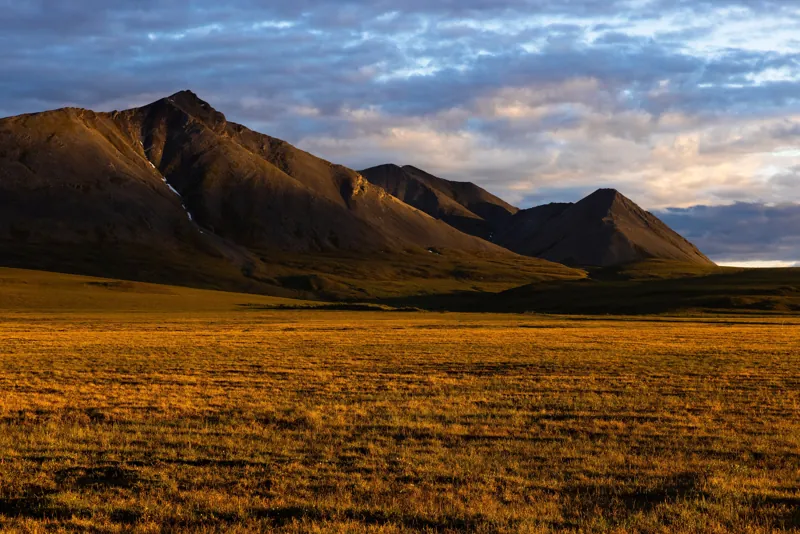
In Utqiaġvik, the northernmost city in the United States, NASA says the Sun did not dip below the horizon between 10 May and 2 August 2025, a whopping 84 days. Over that time the frozen tundra around the town turns into a mosaic of ponds. [NASA]
Model, not a forecast: the dial is a simplified calculation for teaching, labelled as ours. For official sunrise and sunset times, use a national weather or astronomy service.